Ford is NOT working for workers
Seven “Working for Workers” laws have passed since Ford came into power. What difference has this made for workers in Ontario?
One year into Premier Ford’s third term in Ontario, we are doing a reality check on labour law changes that were meant to improve conditions for workers.
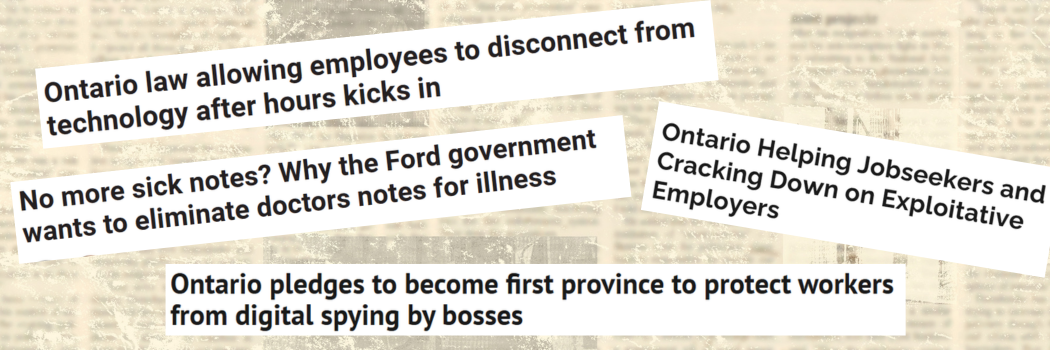
On the surface, catchy headlines make it look like the Ontario government is is on the side of workers.
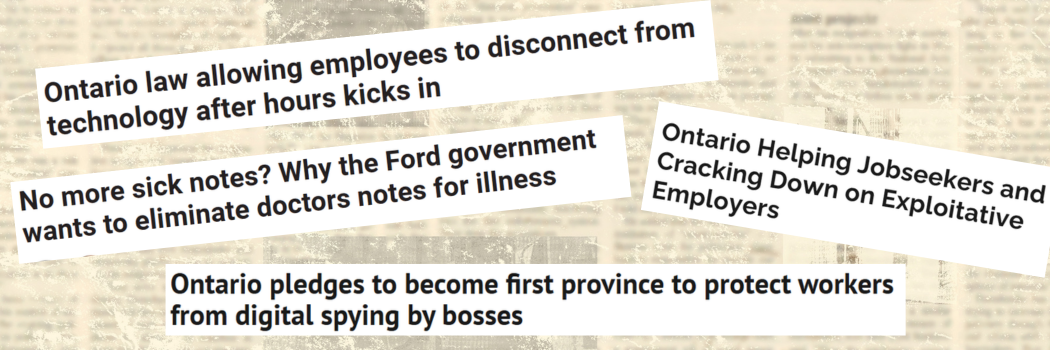
But when you dig just under the surface, many of these laws do not translate into meaningful rights and protections for workers!
We are tackling three reasons why Premier Ford’s is NOT working for workers.
- Passing labour laws without substance
- Taking credit for fixing what they broke
- Corporate handouts masked as worker rights
1) Passes labour laws without real substance
Privacy Rights in the Workplace
Claim: In 2022, the Ford government press release claimed that “Ontario would become the first province to require electronic monitoring policies and protect workers’ privacy.”
Fact: Yet as the Ministry of Labour’s own Employment Standard Act guide states these new requirements “do not establish a right for employees not to be electronically monitored by their employer” and “do not create any new privacy rights for employees.” In other words, employers are still allowed to monitor us at work. They just have to tell you that they do it.
Unpaid training and trial shifts
Claim: In 2023, Premier Ford banned unpaid trial shifts for restaurants and hospitality workers.
Fact: Unpaid trial shifts were already illegal. Our labour laws are clear: If you work, you must be paid for your time. This is true whether your employer calls it a trial shift, probation or training shifts.
What is more urgent is actual enforcement of our rights and the right to complain without reprisal. Workers are routinely not paid for training shifts and additionally many workers do not get paid properly for overtime, holiday pay or even get their tips. Workers cannot speak up while they are still employed as they don’t have “just cause” protection which means the employer does not have to have a reason for firing you. We know that many workers get fired or are forced to leave when they ask for their rights. This is why the Workers' Action Centre has launched a Wage Theft Campaign.
2) Taking credit for fixing what they broke
Sick Notes for Sick Days
Claim: In 2024, the Ford government banned employers from requesting sick notes for workers to take their 3 days of job-protected unpaid sick days a year.
Fact: But back in 2018, workers had 10 personal emergency leave days which they could use for any emergency including sickness. 2 of these were paid. And back then, employers could not ask workers to provide a sick note.
It was Premier Ford’s Bill 47 (the Making Ontario Open for Business Act ) that allowed employers to ask for sick notes despite opposition from healthcare professionals. So now, although workers do not have to provide a sick note to take a sick day, they have much fewer sick days a year and none of them are paid. This means many workers have no choice to go to work sick.
Pay Equity and Pay Transparency
Claim: Starting in 2026, the Ontario government requires public job postings to include salary ranges, providing pay transparency that helps close the gender and racialized wage gap.
Fact: The current law allows employers to post salary ranges up to $50,000. This is a problem as there is a big difference between a $30,000 and $80,000 a year job. Furthermore, the law does not even require the employer to offer you a job in that salary range - they just need to include it in the posting.
It is important to remember that back in 2018, we had stronger laws to close the gender and racial wage gap.
This included equal-pay-for-equal-work legislation that was in effect for 8 months that ensured workers had to be paid the same if they did the same work, regardless if they were part-time, temporary or on contract. This legislation was critical to addressing the racial and gender pay gap as many workers in precarious employment are disproportionately racialized workers and women. When Doug Ford came into power in 2018, this was one of the first pieces of legislation they attacked and removed within their first 6 months in office.
Another piece of legislation that was passed but the Ford government failed to enact was pay transparency legislation that went beyond job postings. This legislation would have tracked actual salaries, pay gaps based on gender, ethnicity and shared that information with the province. This law was never implemented.
3) Corporate handouts masked as worker rights
Gig-worker Rights
Claim: In 2025, Ontario gig-workers (working at companies like Uber, Lyft or Doordash drivers) now must be paid at least minimum wage amongst other rights and protections under the Digital Platform Workers' Rights Act.
Fact: This actually denies all gig-workers basic rights under the Ontario Employment Standards Act (ESA). Lobbyists for Uber and other ride-share companies were pushing for gig-workers to remain as self-employed independent contractors so they are exempt from the ESA. And that is what they got.
And while gig-workers must be paid minimum wage, the law only applies for “engaged time.” This does not include the time workers are waiting for their next delivery job. This is like saying servers at a coffee shop should only be paid for the time when they are serving customers.
Furthermore, the law does not ensure gig-workers are compensated for employment expenses. Fuel, vehicle maintenance, insurance and phone plans are costs that are still passed to workers and result in many workers making less than minimum wage.
We need to build a movement for decent work that can win real protections and enforcement!
We need to organize and reach out to workers in our unions and in our communities to win the changes that will make a real difference in our lives.
This includes fighting for:
-
10 Employer-Paid Sick Days: Nobody should have to decide to go to work sick just to pay the bills.
-
Just Cause protection and protection for “concerted” activity: We need the power and job protection to enforce our rights while we are working. We should be able to organize and take action without employer interference and repression.
-
Equal Pay for Equal Work: We still have a huge gender and racial pay gap. We need to legislate equal pay and benefits for equal work regardless of our status as part-time, contract or temporary workers, or gender, racialization and immigration status.
-
Make employers follow the law: Our laws are only as strong as they are enforced. But in the last 10 years, $80 million dollars of wages have remained unrecovered by the Ministry of Labour.
We need real enforcement and to close gaps in the law that allow employers to evade responsibility. To learn more and join the Workers' Action Centre's campaign to Stop Wage Theft.
